
broader impacts
Press

How neuroscience comics add KA-POW! to the field: Q&A with Kanaka Rajan
Dr. Rajan uses comic strips in her research papers to simplify complex concepts and make neuroscience more accessible.
Read More
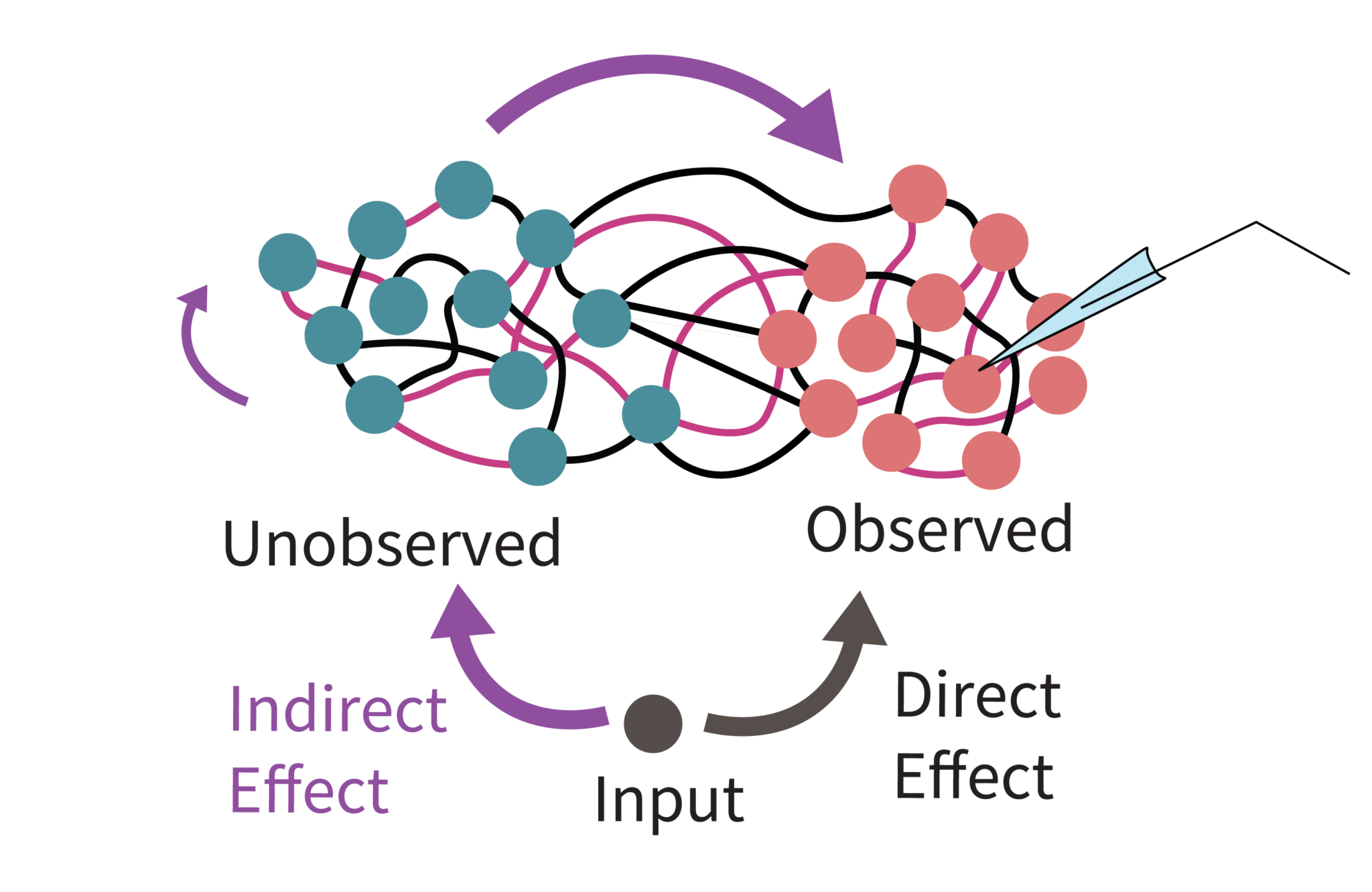
InputDSA: Demixing then comparing recurrent and externally driven dynamics in complex systems
We explored how to measure the similarity between two complex systems when they are driven by external inputs, like biological neural circuits or reinforcement learning agents. Our novel method, called InputDSA, disentangles each systems’ intrinsic dynamics from its input-driven effects, enabling highly accurate, robust, and efficient comparisons of those components.
Read More
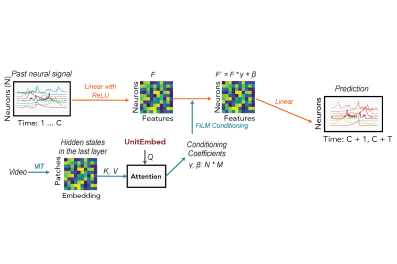
Forecasting the brain: Scalable neural prediction with POCO
Predicting future neural activity is a critical step toward achieving real-time, closed-loop neurotechnologies. To this end, we introduce POCO, a unified forecasting model trained on diverse calcium imaging datasets across species—from zebrafish to mice. POCO achieves state-of-the-art accuracy by combining lightweight individual predictors with a global population encoder, and it demonstrates the ability to rapidly adapt to new individuals and uncover meaningful embedding without supervision.
Read More
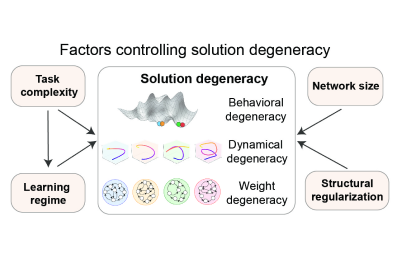
Measuring and controlling solution degeneracy across rask-trained recurrent neural networks
Despite reaching equal performance success when trained on the same task, artificial neural networks can develop dramatically different internal solutions, much like different students solving the same math problem using completely different approaches. Our study introduces a unified framework to quantify this variability across Recurrent Neural Network (RNN) solutions, which we term solution degeneracy, and analyze what factors shape it across thousands of recurrent networks trained on memory and decision-making tasks.
Read More

Deep RL, deep behavior analysis and scalable neural forecasting
Prof. Kanaka Rajan is Associate Professor of Neurobiology at Harvard Medical School, and a founding faculty member of the Kempner Institute for the Study of Natural and Artificial Intelligence at Harvard University. Her research seeks to understand how important cognitive functions—such as learning, remembering, and deciding—emerge from the cooperative activity of multi-scale neural processes.
Read More
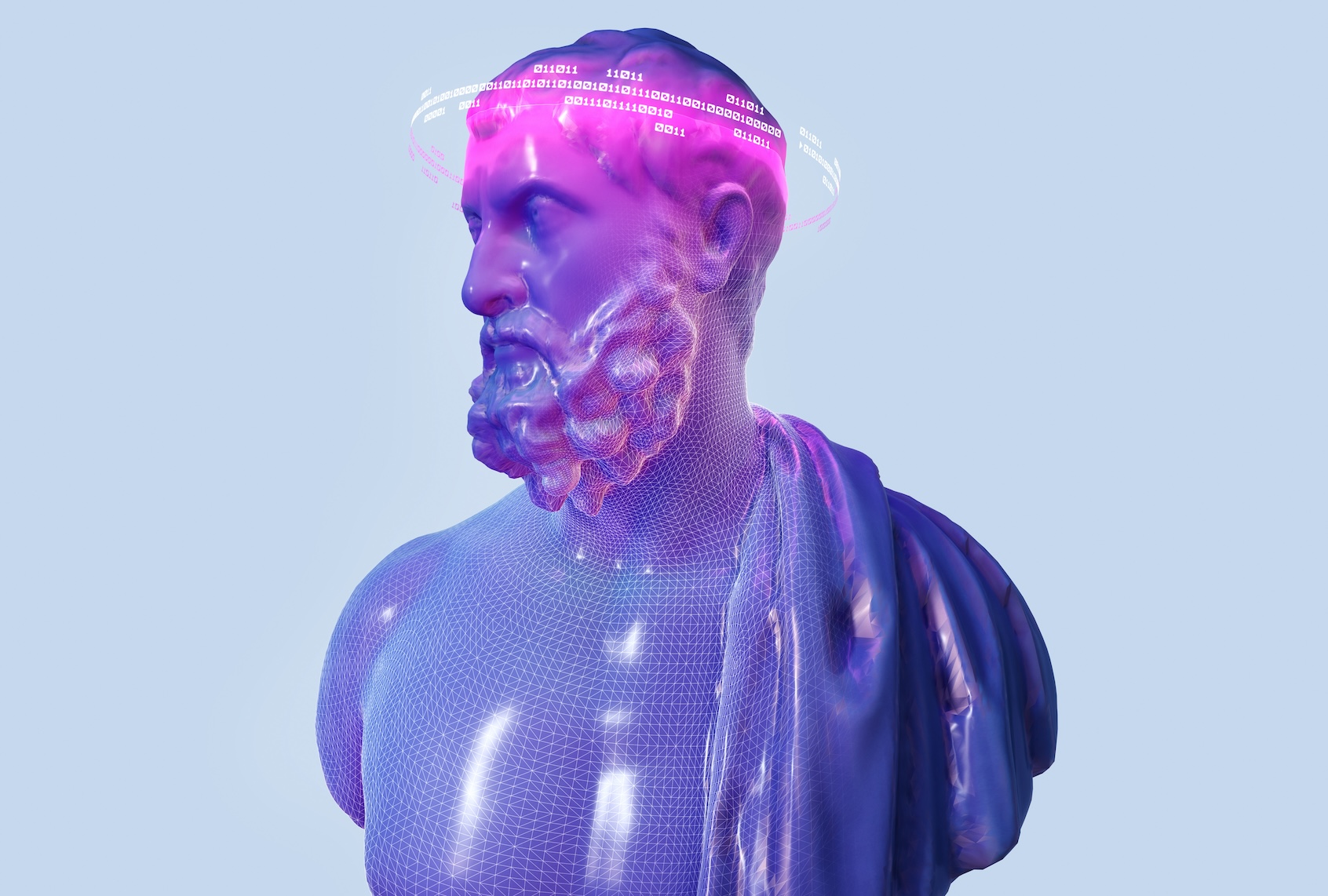
We’re offloading mental tasks to AI. It could be making us stupid
Whether we lose some of the skills artificial intelligence performs for us largely depends on how we use this tech
Read More

More brainlike computers could change AI for the better
New brain-inspired hardware, architectures and algorithms could lead to more efficient, more capable forms of AI.
Read More

What electric fish can teach scientists about NeuroAI
Modeling their behaviors may help in the development of new AI systems.
Read More

Princetonians win early-career presidential science awards
Six current Princetonians and at least 14 researchers with ties to the University are among the 2024 recipients of the Presidential Early Career Awards for Scientists and Engineers (PECASE), awarded by President Biden on Jan. 14.
Read More

Neural-network analysis posits how brains build skills
Discrete computational subunits may offer mix-and-match motifs for cognition...
Read More

The risks of artificial intelligence in weapons design
Researchers outline dangers of developing AI-powered autonomous weapons...
Read More

Putting artificial neural networks to the task
Inspired by the human brain, artificial neural networks are the heart of artificial intelligence...
Read More

Computational neuroscience and the joy of discovery with Dr. Kanaka Rajan
In this interview, Kanaka explores her proudest work, her motivations, and shares advice for young female scientists entering an area of research that remains male-dominated.
Read More

Women in science: Motivation, challenges and advice
Kanaka and other leading female scientists discuss why they were drawn to science as well as share tips for women looking to embark on a career in STEMM.
Read More

Is the brain uncontrollable, like the weather?
The brain may be chaotic. Does that mean our efforts to control it are doomed?
Read More

Building models of the brain to take them apart
Detailed computational models of the brain are being developed to better understand its complex functions. Researchers aim to dissect and analyze brain mechanisms by simulating neural circuits, potentially leading to breakthroughs in understanding neurological diseases.
Read More

Neuroscience and AI: On the limits of biology with Kanaka Rajan
The intersection of neuroscience and AI, and the limitations and potential of both fields. Biological insights can enhance AI models, and AI can, in turn, provide new perspectives on brain functions.
Read More

In AI, is bigger always better?
A debate on whether larger AI models lead to better performance. Bigger models often show improved results, but they come with significant computational costs and diminishing returns, raising questions about the efficiency and practicality of scaling.
Read More

Bridging neurobiology and artificial intelligence with Kanaka Rajan
Efforts to integrate neurobiological insights with AI development. Researchers aim to create more efficient and adaptable AI systems by mimicking brain structures and functions, potentially revolutionizing technology and medicine.
Read More
.avif)
Sleep helps AI models learn new things without forgetting old ones
Parallels between human sleep and AI training are drawn to explain how simulating sleep processes in AI can prevent catastrophic forgetting. This approach helps AI systems retain old knowledge while acquiring new information, enhancing their learning capabilities.
Read More

The tale of two intelligence fields: AI and Neuroscience
Conversation on the convergence of AI and neuroscience, highlighting how insights from brain research inform AI development, and vice versa. Mutual benefits and the potential for groundbreaking advancements in understanding intelligence and creating innovative technologies are discussed.
Read More

Computational neuroscientist opens doors for new ideas and talent to thrive
Discusses the role of computational neuroscientists in fostering innovation and nurturing new talent. Focuses on their contributions to advancing the field through mentorship, interdisciplinary collaboration, and pioneering research that bridges theoretical and practical applications.
Read More

The science life: Kanaka Rajan
A profile of Dr. Kanaka Rajan, detailing her journey and achievements in computational neuroscience. Describes her research focus, contributions to the field, and the impact of her work on understanding brain functions and developing AI models are described.
Read More

How to successfully collaborate with a computational neuroscientist
Strategies for effective collaboration with computational neuroscientists. Emphasis on the importance of interdisciplinary communication, setting clear goals, and understanding the unique challenges and opportunities that arise from integrating computational and experimental approaches.
Read More

To be energy-efficient, brains predict their perceptions
Investigates the brain's energy efficiency through predictive processing. Explains how the brain minimizes energy expenditure by anticipating sensory inputs and adjusting neural responses accordingly, offering insights into fundamental principles of brain function and potential applications in AI.
Read More

Dr. Kanaka Rajan on modularity of the brain, neural dynamical motifs, and learning ‘true grit’
Highlights Dr. Kanaka Rajan's research on brain modularity and neural dynamics and her findings on how the brain's modular structure and dynamic motifs facilitate learning and adaptation. Discusses how this research sheds light on fundamental neural processes and resilience.
Read More

Rebuilding the brain from AI ‘Legos’ with Kanaka Rajan
Outlines Dr. Kanaka Rajan's innovative approach to modeling brain functions using AI components. By assembling AI ‘Legos’, she aims to reconstruct complex neural circuits, enhance understanding of brain mechanisms and inform the development of more sophisticated AI systems.
Read More

Modeling human cognition with RNNs and curriculum learning with Kanaka Rajan
Exploration of recurrent neural networks (RNNs) and curriculum learning to model human cognition. Discusses Dr. Kanaka Rajan's research on how these AI techniques can simulate cognitive processes, offering new perspectives on brain functions and improving AI learning algorithms.
Read More

Dr. Kanaka Rajan, computational neuroscientist & Assistant Professor at Mt. Sinai
An overview of Dr. Kanaka Rajan's career and contributions as a computational neuroscientist and assistant professor at Mt. Sinai. Highlights her research achievements, educational background, and the impact of her work on the fields of neuroscience and AI.
Read More

566: Dr. Kanaka Rajan: Creating computational models to determine how the brain accomplishes complex tasks
Discusses Dr. Kanaka Rajan's efforts to simulate complex neural processes, uncover how the brain performs intricate tasks, and inform the design of advanced AI systems.
Read More

Tracking information across the brain
Methods for mapping information flow in the brain are discussed. Highlights techniques used to trace neural pathways and monitor brain activity, providing insights into how information is processed, stored, and utilized across different brain regions.
Read More

BI 054 Kanaka Rajan: How do we switch behaviors?
Dr. Kanaka Rajan's research on behavioral switching in the brain. Findings on the neural mechanisms that enable the transition between different behaviors, shedding light on adaptive functions and potential applications in neuroprosthetics and AI behavior modeling.
Read More

%20(1)%20(1).png)